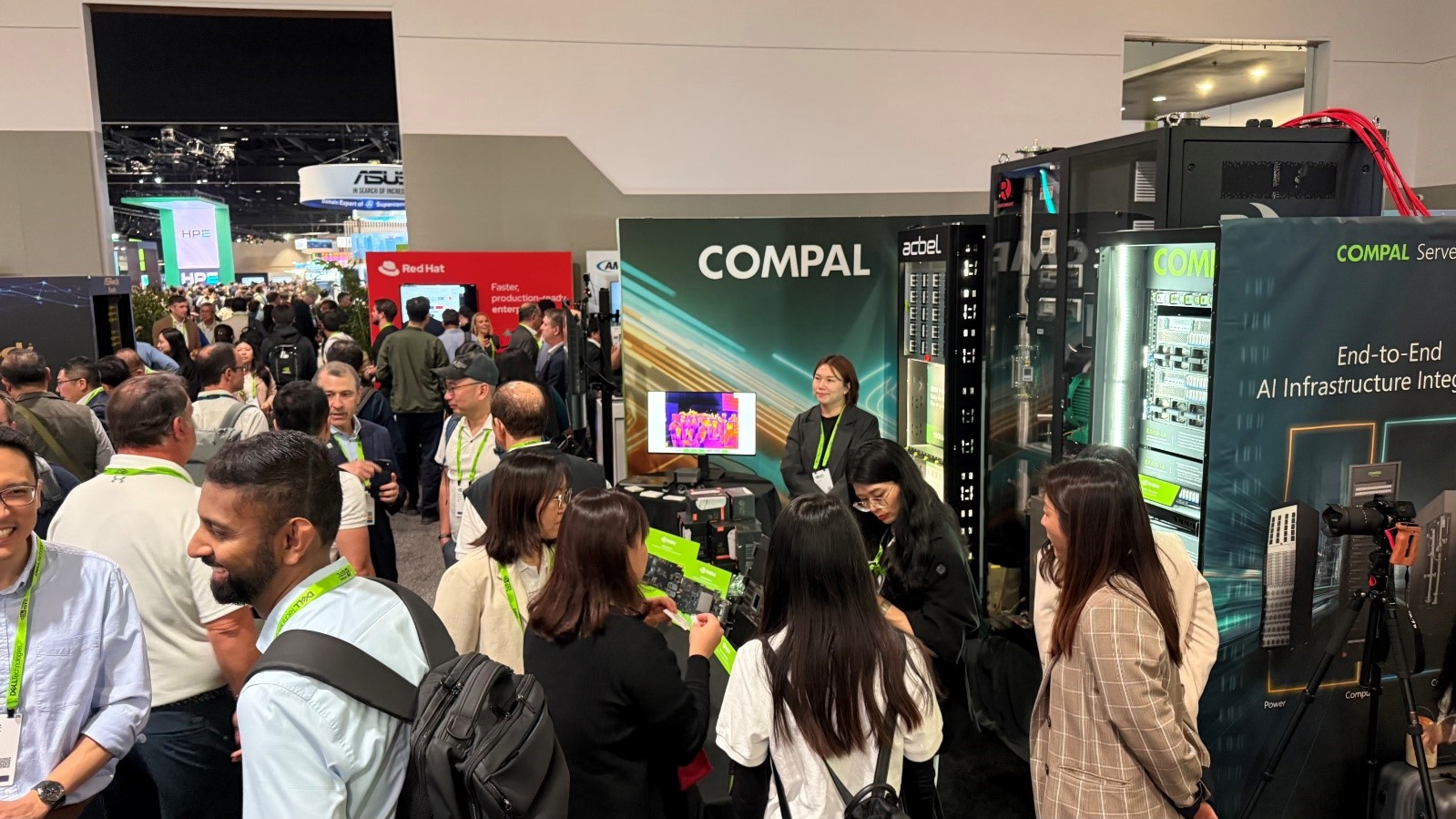
At NVIDIA GTC 2026, Compal showcased its high-density AI server solution based on NVIDIA HGX Rubin NVL8, aligning with the NVIDIA’s “Six New Chips – One AI Supercomputer” NVIDIA Vera Rubin architecture and demonstrating its engineering readiness for next-generation AI supercomputing infrastructure.
The NVIDIA Vera Rubin architecture integrates the NVIDIA Vera CPU, NVIDIA Rubin GPU, NVIDIA NVLink 6 Switch, NVIDIA BlueField-4 DPU, NVIDIA Spectrum-X Ethernet and NVIDIA ConnectX-9 SuperNIC to form a comprehensive heterogeneous computing architecture. Powered by NVLink 6 switching technology, the NVL72 rack-scale configuration delivers up to 260 TB/s of total bandwidth and enables 3.6 TB/s of all-to-all bandwidth per GPU, supporting MoE models and large-scale training and inference workloads.
Compal is introducing the SG231-2-L1, based on NVIDIA HGX Rubin NVL8.
The core value of the SG231-2-L1 includes:
- High-Density Accelerated Architecture: Integrates eight NVIDIA Rubin GPUs within a 2U chassis, maximizing compute density and space efficiency.
- Advanced Inference Performance: Delivers up to 400 petaFLOPS (NVFP4), supporting LLM training and inference, generative AI, and HPC workloads.
- High-Bandwidth GPU Interconnect: Powered by NVIDIA NVLink 6, enabling up to 28.8TB/s of GPU-to-GPU bandwidth for enhanced multi-GPU scalability.
- Scalable Memory Architecture: Supports up to 2.3TB of GPU memory and 176TB/s of memory bandwidth for memory-intensive AI applications.
- High Power Density with Liquid Cooling: Sustains approximately 24kW of system power through optimized direct liquid-cooling design for stable, sustained performance.
- Rack-Level Deployment Readiness: Designed for seamless integration into high-density AI racks, supporting scalable expansion from single nodes to data center deployments.
In its booth, Compal is also featuring an NVIDIA Vera CPU HPM module based on NVIDIA HGX system, highlighting engineering readiness and manufacturing capabilities aligned with the NVIDIA Vera Rubin platform. As heterogeneous computing architectures continue to evolve, coordinated CPU-GPU design has become a critical factor for data centers.
Complementing this showcase, Compal is also introducing support for the new NVIDIA RTX PRO 4500 Blackwell Server Edition—featuring 32GB GDDR7 memory and up to 800 GB/s bandwidth, enabling efficient acceleration for AI inference, data processing, and visual computing workloads.
Alan Chang, Vice President of Compal’s Infrastructure Systems Business Group, stated:
“Competition in AI infrastructure has shifted from single-node performance comparisons to overall deployment efficiency and long-term scalability. As the NVIDIA HGX Rubin NVL8 platform advances in both performance and power density, data center architecture must evolve accordingly. We are strengthening not only compute capability, but also the load-bearing and expansion capacity of the entire infrastructure stack, enabling customers to establish sustainable deployment models for next-generation AI workloads.”
As AI workloads continue to scale, data center competitiveness is increasingly defined by ecosystem alignment and holistic architectural integration. Through its showcase at GTC 2026, Compal demonstrates engineering strength in high-density GPU systems and liquid cooling solutions while reinforcing its long-term strategic engagement within the NVIDIA technology ecosystem.